
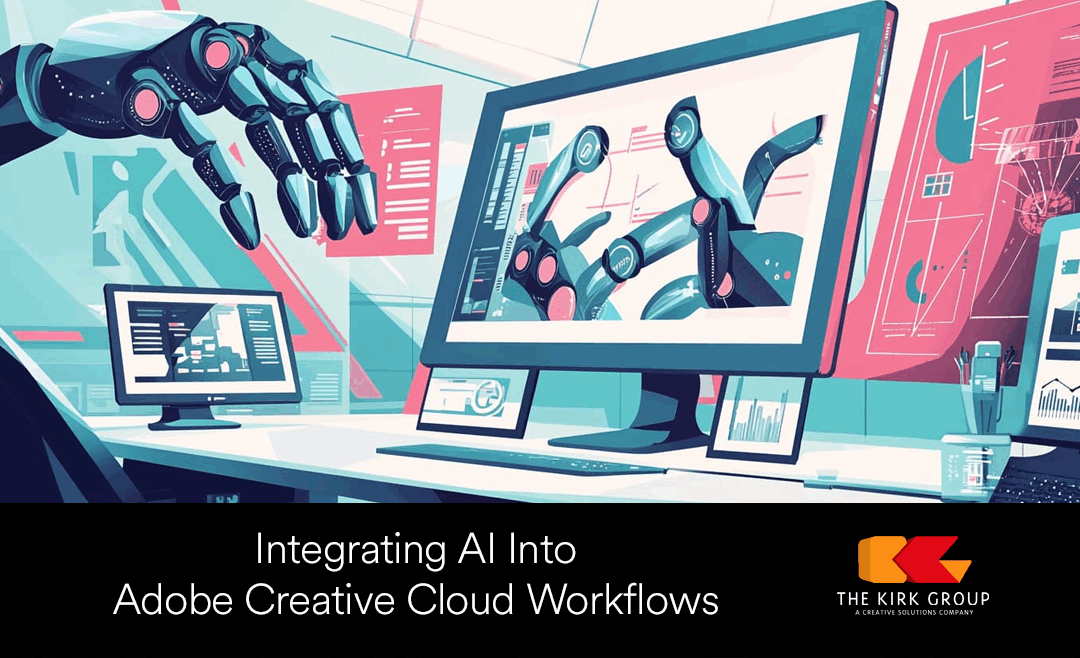
Have you considered how artificial intelligence could transform the way you work inside Adobe Creative Cloud?
Integrating AI Into Adobe Creative Cloud Workflows
You’re about to read practical, real-world ways to fold AI into your Creative Cloud processes so you can increase speed, maintain creative quality, and improve profitability without losing the human touch. This article gives you actionable steps, tool recommendations, and governance guidance so you can start small and scale the impact across design, marketing, and client services.
Why integrate AI with Creative Cloud?
You want faster ideation, more predictable outcomes, and fewer repetitive tasks eating into billable hours. Integrating AI into Creative Cloud helps you automate routine work, generate creative starting points, and surface data-driven decisions that keep your team focused on high-value design problems.
The promise vs. the reality
AI can shorten timelines and amplify output, but it won’t replace the unique creative judgment you bring to a project. You’ll see the best results when AI augments human workflows rather than acting as an unchecked substitute.
Key AI tools that complement Creative Cloud
Knowing which tools fit which job helps you choose the right integration approach for your needs. Below are the most relevant tools and their primary uses when paired with Adobe Creative Cloud.
| Tool | Primary uses with Creative Cloud | How it connects |
|---|---|---|
| Adobe Sensei / Firefly | Generative images, text-aware editing, content-aware fills | Native in Photoshop, Illustrator, InDesign, and Premiere |
| ChatGPT (or similar LLMs) | Briefs, copywriting, prompts, creative concepts | Via web, API, and plugin-based workflows |
| Midjourney / Stable Diffusion | High-concept image ideation, textures, moodboards | External generation → import into Photoshop/Illustrator |
| Runway | Video editing, background removal, generative motion | Exports to Premiere/After Effects and direct cloud assets |
| DALL·E | Quick image variants for social and ads | Use external generation then import assets |
| Automation platforms (Zapier, Make) | Project automation, notifications, file transfers | Connect Creative Cloud API to PM tools |
| Adobe I/O, UXP | Custom plugins and integrations | Build tight app-to-app workflows |
You can mix and match these tools according to budget, privacy needs, and the creative stage where you want help.
Assessing your current workflow
Start by mapping how files, tasks, and approvals currently flow through your team to find the highest-impact automation opportunities. When you understand where time is spent, you’ll be able to pilot AI in ways that reduce bottlenecks and increase creative throughput.
Create a workflow audit checklist
Use this checklist to capture the repetitive steps and pain points that AI can address. You’ll want to document time-per-step, responsible roles, and error rates.
| Audit item | What to capture |
|---|---|
| Repetitive tasks | Exporting, resizing, color-correcting, captioning |
| Time sinks | Average minutes/hours spent per task |
| Creative bottlenecks | Waiting on feedback, large asset searches |
| Compliance risks | Client IP, licensed assets, data privacy concerns |
| Tools used | Plugins, external apps, manual processes |
You can use these findings to prioritize quick wins such as automating exports or generating captions.
Practical use cases inside Adobe apps
Putting AI into practice looks different depending on whether you’re working in Photoshop, Illustrator, InDesign, Premiere Pro, or After Effects. Below are targeted examples for each app that you can try today.
Photoshop: Generative editing and workflows
You can use generative fill to remove, replace, or extend image areas and merge AI-generated content with existing assets. This saves time on compositing tasks and helps you iterate variations fast while keeping creative control.
Illustrator: Logo and vector ideation
AI can produce multiple vector concepts as starting points that you refine for brand consistency and production readiness. Use generated assets as sketches, then trace, refine, and vectorize with clean paths and constrained color systems.
InDesign: Automating layout and variable data
You can link AI-generated copy to layout templates and generate multiple design variants for localized content or campaign testing. This reduces manual layout work and keeps typography and grid systems consistent.
Premiere Pro: Faster editing and transcription
AI features like speech-to-text, auto-reframe, and scene detection speed up editing cycles and make content repurposing easier across aspect ratios. You’ll cut down the hours spent on manual cuts and caption creation for social platforms.
After Effects: Motion creation and rotoscoping
Generative tools reduce the manual frame-by-frame work for rotoscoping and allow you to create motion assets from simple prompts. This helps you prototype motion ideas rapidly before committing to detailed animation.
Building an AI-in-Cloud integration architecture
You need a reliable architecture to move assets between AI tools and Creative Cloud, handle metadata, and enforce version control. Plan how generated assets will flow from source to production and how they’ll be tracked.
Components of a simple integration architecture
Think in terms of connectors, storage, transformation, and governance layers to avoid ad hoc file transfers that break consistency.
| Layer | Role |
|---|---|
| Connectors | APIs, plugins, webhooks that move data |
| Storage | Creative Cloud Libraries, cloud docs, DAMs |
| Transformation | AI models and scripts that generate or optimize assets |
| Orchestration | Automation platform or custom scripts to sequence tasks |
| Governance | Access control, audit logs, metadata for provenance |
You’ll typically combine native Creative Cloud features with middleware or custom plugins to get a smooth integration.
Prompt engineering for design workflows
You’ll get better AI outputs by treating prompts like design briefs: be specific about style, constraints, and technical specs. Iterative prompting and refining outputs will become a core skill for your team.
Prompt templates you can reuse
Templates speed up consistent result generation and help junior staff produce on-brand concepts quickly.
| Use case | Prompt template |
|---|---|
| Social image variant | “Create a high-contrast, 1080×1080 image for X brand with [product] centered, minimal copy ‘Y’, color palette [A,B,C], photorealistic style.” |
| Logo exploration | “Generate 8 logo concepts for [brand name], values: [X, Y, Z], simple vector forms, mono or dual-tone, scalable to 48px.” |
| Hero banner copy | “Write 3 headline alternatives (6–10 words) and 3 supporting lines for a hero banner promoting [offer]. Tone: [friendly/professional/urgent].” |
You should keep a centralized library of prompt templates for repeatable brand tasks.
Managing assets and libraries
Creative Cloud Libraries and cloud documents become more important as you scale AI-generated content to avoid fragmentation. You’ll want consistent naming, metadata, and tagging for discoverability and legal tracking.
Metadata and provenance
Tag every AI-generated asset with metadata that records the model used, date created, prompt text, and licensing status so you can audit origins later. That provenance data protects you if legal questions or client concerns arise.
Automating routine production tasks
Automation frees your team from repetitive steps like export variants, watermarking, and format conversions. You’ll reduce human error and speed up delivery cycles.
Example automation flows
You can use Adobe I/O, Zapier, or Make to chain tasks: when a Creative Cloud asset is approved, automatically export JPG/PNG/PDF variants, upload to client folder, and notify stakeholders. Automating review links and version exports saves hours every week.
Client communications and approvals
AI can draft client emails, summarize feedback, and produce change lists from review comments so you spend less time rewriting messages. Use AI as a first-draft generator and always perform a human review before sending client-facing content.
Use case: Summarizing client feedback
Upload client comments or meeting transcripts to an LLM to get a prioritized action list with estimates and responsible owners. This reduces miscommunication and helps you give clients clear next steps.
Measuring success: KPIs and ROI
You’ll want to measure how AI affects speed, cost, and quality so you can justify further investment. Choose metrics tied to business outcomes such as time saved, billable hours returned, error reduction, and conversion lift.
Sample KPI dashboard items
Track things like average project turnaround, number of design iterations per project, time spent on repetitive tasks, and campaign performance lift after AI-assisted personalization. These metrics help you connect AI activity to revenue and client satisfaction.
Legal and ethical considerations
You must handle copyright, licensing, and client IP carefully when using generative models, and you should be transparent with clients about how assets were produced. It’s important to have policies that ensure you don’t unknowingly use protected works in model outputs.
Best practices for compliance
Keep source prompts and output logs, use licensed datasets where possible, secure client approval for AI-generated assets, and consult legal counsel for brand-sensitive work. These steps reduce risk and build client trust.
Quality control and the human-in-the-loop
AI output requires human oversight to meet brand standards and technical specifications. Set up review gates where creatives edit and approve AI-generated content before final use.
Staged QA checklist
Validate outputs for brand color, typography, legal compliance, accessibility, and technical specs (resolution, bleed, safe area). Having a checklist preserves quality and helps junior staff follow standards.
Training your team and managing change
People adopt technology faster when they understand use cases and see clear benefits to their daily work. You’ll have better uptake if you run workshops, hands-on demos, and create role-specific playbooks.
Steps to train and scale skills
Start with pilot projects, provide short tutorials, encourage sharing of prompt libraries, and assign AI champions to help others. Progressive training reduces resistance and builds confidence.
Setting up pilot projects
Pilot projects let you validate ROI before a full rollout and help you refine governance policies. Choose projects with clear, measurable outcomes and low client risk for initial tests.
Pilot selection criteria
Prefer internal campaigns, social assets, or content-heavy projects where time savings are easy to measure and quality risk is acceptable. Use pilots to build examples that sales and account teams can show to clients.
Integrating APIs and plugins
You can build custom workflows by using Adobe I/O, Creative Cloud APIs, and UXP plugins to automate exports, trigger model runs, or fetch generated assets directly into your documents. These custom integrations make AI feel native inside the apps you use every day.
Typical integrations to consider
- Auto-run a generative image workflow when a new brief is created.
- Push final assets into a DAM with metadata from the prompt.
- Trigger client review links and Slack notifications after approval.
Collaboration patterns for mixed teams (design + data)
Your design team will work best when data, marketing, and analytics teams provide structured inputs, such as customer segments and performance metrics. This improves the quality of AI-driven personalization and reduces rework.
Example cross-team workflow
Data team supplies segment criteria → AI generates personalized copy/creative variations → Design refines and pins templates → Marketing runs A/B tests and feeds back performance data. This loop improves over time.
Cost management and vendor selection
You’ll need to balance subscription costs, API usage, and compute expenses against your expected savings in time and headcount. Consider a tiered approach where lower-cost models handle routine tasks and higher-quality models are reserved for brand-critical work.
Cost control tips
Monitor API usage, cache frequent prompts/outputs for reuse, and set rate limits or quotas per user. Having budgets and guardrails prevents surprises in monthly bills.
Common pitfalls and how to avoid them
You’ll see poor results if prompts are vague, if there’s no version control, or if AI outputs are published without human review. These pitfalls can degrade brand consistency and create legal or client-relations issues.
Mitigation strategies
Implement prompt templates, versioning systems, and mandatory review steps for any client-facing material. These small guardrails maintain quality and trust.
Accessibility and inclusivity
AI can help you spot accessibility issues, generate alt text, and test color contrast, but you still need experts to ensure content truly meets accessibility standards. Use AI as an assistant for compliance checks rather than the final authority.
Quick wins for accessibility
Automatically generate alt text and transcripts, then have a human editor verify accuracy and context. These tasks reduce manual workload while improving inclusivity.
Scaling from pilot to full implementation
Once pilots prove value, create a phased rollout plan with prioritized workflows and training schedules. You’ll get better adoption if you combine technical rollout with cultural change management.
Phased rollout roadmap
Phase 1: Low-risk automations (exports, captions).
Phase 2: Creative augmentation (generative concepts, templates).
Phase 3: Full personalization pipelines (dynamic creative optimization).
This staged approach reduces disruption and allows for continuous learning.
Case scenarios and practical examples
Seeing specific examples helps you picture how to apply AI to your work. Below are concise scenarios you can adapt to your agency or marketing team.
Scenario: Faster social content production
You have a weekly social calendar requiring 28 image variants and captions. Use generative models to produce image concepts and caption variations, automatically export size variants from Photoshop or Premiere, and route approved assets to scheduling tools. You’ll reduce per-post labor and free designers to work on strategy.
Scenario: Automated client reporting and creative suggestions
After a campaign, feed performance data into an LLM to generate a concise report with insights and suggested tweaks for creative testing. This saves account managers time and provides data-driven guidance for creative iterations.
Templates and playbooks to get started
Templates speed up adoption and keep results consistent across your team. Create prompt libraries, file templates for common sizes, and approval checklists so new users can follow proven processes.
Essential internal playbooks
- Prompt library with examples for hero images, social posts, and copy.
- Brand QA checklist for AI-generated content.
- Project template with automated export rules and naming conventions.
Security, IP, and client transparency
You should have explicit statements in client contracts about the use of AI, how outputs are generated, and who owns final assets. Transparency builds trust and prevents misunderstandings about provenance or licensing.
Example policy elements to include
- Disclosure clause about AI-assisted asset creation.
- Assignment of IP rights for final, human-approved deliverables.
- Audit logs and metadata retention requirements.
Long-term strategy and future-proofing
Plan for increasing native AI features inside Creative Cloud and more robust model ecosystems. You’ll want to keep processes flexible so you can swap models or scale compute without redoing your entire pipeline.
Investment priorities
Invest first in governance, metadata, and training; these are evergreen regardless of which model or vendor you use next. Prioritize interoperability and modular integrations to avoid vendor lock-in.
Quick wins you can implement in 30 days
You can achieve visible benefits in a month by automating a handful of tasks and training a small team on prompts. These wins will produce early ROI and build momentum for broader adoption.
| Quick win | Expected benefit |
|---|---|
| Auto-generate captions and timestamps for video | Save editorial time and speed publishing |
| Use generative fill for batch background removal | Faster image prep for e-commerce and social |
| Create prompt templates for social image variants | Reduce creative iteration cycles |
| Automate export presets via Creative Cloud APIs | Consistent outputs and reduced manual errors |
Start with one or two of these and measure the time saved.
Building a business case for leadership
Frame AI investments in terms of reduced turnaround time, increased billable capacity, and improved client satisfaction. Use pilot data to project annualized savings and tie them to hiring or revenue goals.
Example ROI calculation
If automations save 4 hours per week per designer and you have 5 designers at $50/hr loaded cost, that’s $52,000/year recovered in capacity from one automation. Present these conservative estimates to stakeholders to secure funding.
Final checklist: first 90 days
This short checklist guides your first three months of integrating AI into Creative Cloud so you get measurable outcomes quickly.
| 0–30 days | 31–60 days | 61–90 days |
|---|---|---|
| Run a workflow audit and pick 1–2 pilots | Build prompt templates and set up simple automations | Evaluate pilots, measure KPIs, refine governance |
| Train a small team and create a prompt library | Implement Creative Cloud Library and metadata rules | Plan phased rollout and budget for scale |
| Draft client disclosure language | Add review gates and QA checklists | Present ROI and roadmap to leadership |
Following this path keeps your rollout pragmatic and focused on business value.
Conclusion and next steps
You can boost creative output, reduce repetitive work, and deliver more personalized campaigns by integrating AI into Creative Cloud thoughtfully and with governance. Start small with measurable pilots, keep humans in the loop for quality and brand control, and scale as you prove ROI and improve team skills.
Actionable next steps:
- Run a short workflow audit to identify one automation and one creative augmentation pilot.
- Build a small prompt library and a QA checklist for AI-generated assets.
- Implement metadata tagging for provenance and create a client disclosure template.
If you follow these steps, you’ll be delivering faster, more consistent, and more profitable creative work without sacrificing the human creativity that makes your work special. In the need for Creative Support? Contact the Kirkgroup today.